
Faithful Citizenship
Office of Family Life and Office of Social Concerns
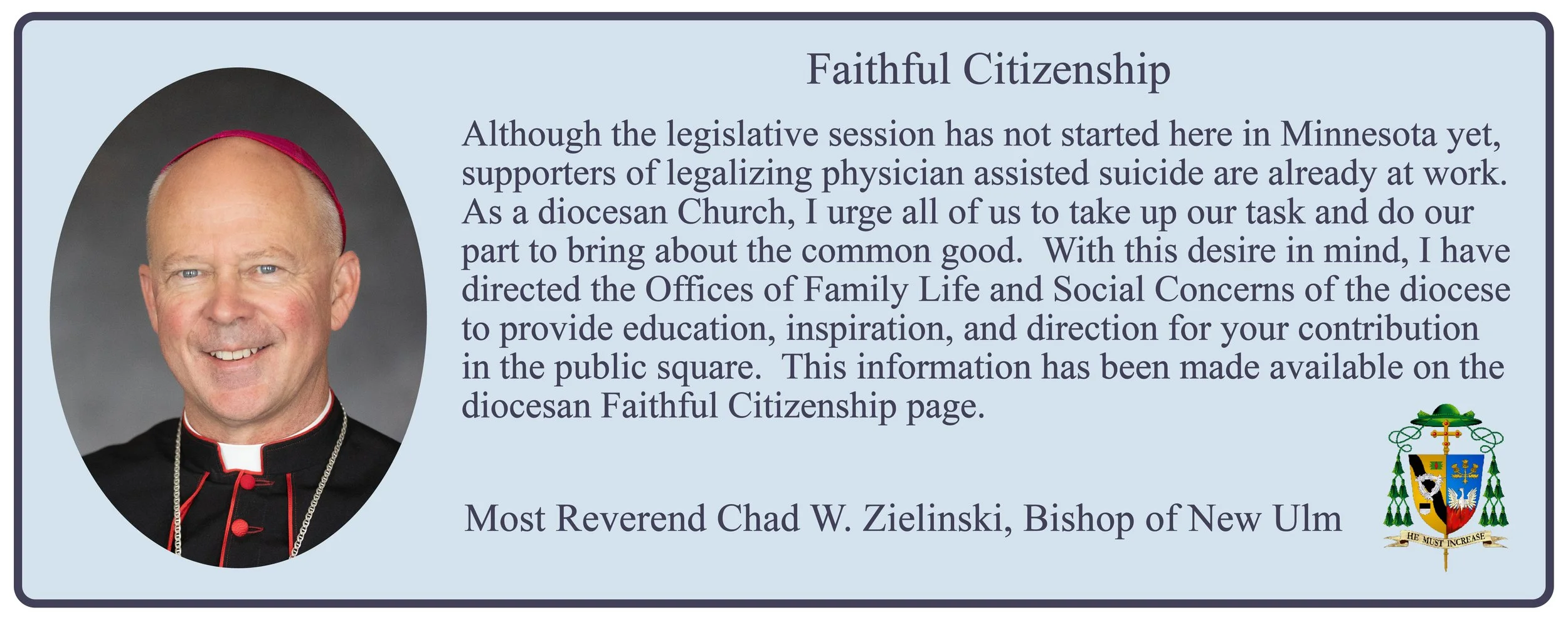
As Catholics, we are called to participate in public life and promote the common good through informed and faithful citizenship.

Pope Leo XIV proceeds to describe three main foundations of Catholic Social Teaching that have emerged over the last 135 years:
Faith
The Human Person as an Image of the Triune God:
This foundation rests Catholic Social Teaching on the nature of the Most Blessed Trinity and the meaning of creation (Gn 1:26 27), recognizing that human beings are called to participate in God’s divine life. As humans, we are interconnected with both rights and responsibilities toward each other.
Human Dignity
Equal Dignity of All Human Beings:
Expressing his concern about the rise of ideologies that link human dignity with one’s ability to contribute to society, Pope Leo XIV affirms that all human beings share an equal dignity grounded in God’s love for all people. The Holy Father thus restates the teaching of the Second Vatican Council, which recognized in 1965 that societies were not recognizing such a dignity. Indeed, this basic failure has caused many of the grave assaults against the human person over the past century.
Common Good
Supreme Value of Human Rights:
Popes have consistently praised the expanded recognition of fundamental human rights in the aftermath of World War II, and Pope Leo XIV adds his voice in so doing. In doing so, he identifies two current threats to the protection of human rights: (1) a formalism that reduces rights to a paper guarantee while technological progress tramples them without any effective recourse, and (2) a lack of foundations whereby society ceases looking for the anthropological root of the general applicability of human rights. Here, the Holy Father expresses a concern already anticipated more than 30 years ago by Pope St. John Paul II.
(Excerpted from the United States Conference of Catholic Bishops' "Outlines for Clergy Formation Sessions on Faithful Citizenship," p. 10.)
Click HERE to view the complete Outlines for Clergy Formation Sessions on Faithful Citizenship document.

The U.S. bishops propose three main themes for preaching faithful citizenship. All three flow organically from Scripture and Tradition; they are not “single-issue” agendas but instead synthetically form part of an integral Catholic way of life:
Transform
The Church’s Role to Transform Society.
Jesus told a brief parable about yeast: “The kingdom of heaven is like yeast that a woman took and mixed with three measures of wheat flour until the whole batch was leavened” (Mt 13:33). Just as a little yeast causes an entire batch of dough to rise and become a fluffy loaf of bread, so the Gospel—and those who respond to it in the life of the Church—allow the values of the kingdom to touch every aspect of society. The laity especially have the role of serving as this leaven in the various secular occupations that they undertake. The clergy seek to support the laity as they fulfill this essential role.
Encounter
“Who Is My Neighbor?”
This question, first posed by the scholar of the law in the leadup to the Parable of the Good Samaritan (Lk 10:29), allowed our Lord to illustrate his answer—it includes even a despised and unwelcome Samaritan. By his Incarnation and Passion, the Lord entered into solidarity with all humanity, so making himself a neighbor to all and inviting all to become a neighbor also. As he said shortly before his Passion, “And when I am lifted up from the earth, I will draw everyone to myself” (Jn 12:32).
Discern
Faith before Politics.
At times, the endless political news cycle can drown out the core convictions of our Catholic faith. Like many Americans, some Catholics choose to expose themselves to a steady stream of information from partisan sources, and this often results in the embrace of partisan viewpoints, such that the faithful embrace political ideologies aligned with a political party rather than allowing their perspectives to be formed by the whole of Church teaching, which does not align itself with any political party or ideology. In embracing partisan viewpoints, the faithful may also come to perceive those with different political opinions as enemies. These tendencies have given rise to a politics in search of a moral justification instead of a sound integral conviction of faith seeking to wisely exercise political discretion. In the midst of such a challenge, a question that we must ask ourselves is how best to accompany Catholics to authentically live the call to faithful citizenship—which embraces the fullness of the Church’s teachings and is a way of living the Gospel in attending to specific duties in the public square, which sit alongside a wide array of other duties.
(Adapted from "Outlines for Clergy Formation Sessions on Faithful Citizenship," pp. 7-8, United States Conference of Catholic Bishops.)
Click HERE to view the complete Outlines for Clergy Formation Sessions on Faithful Citizenship document.

The Minnesota Catholic Conference provides resources to help Catholics form their consciences, engage in civic life, and make informed decisions during the 2026 election cycle.
Practical Resources for Voting
Questions to Ask Candidates
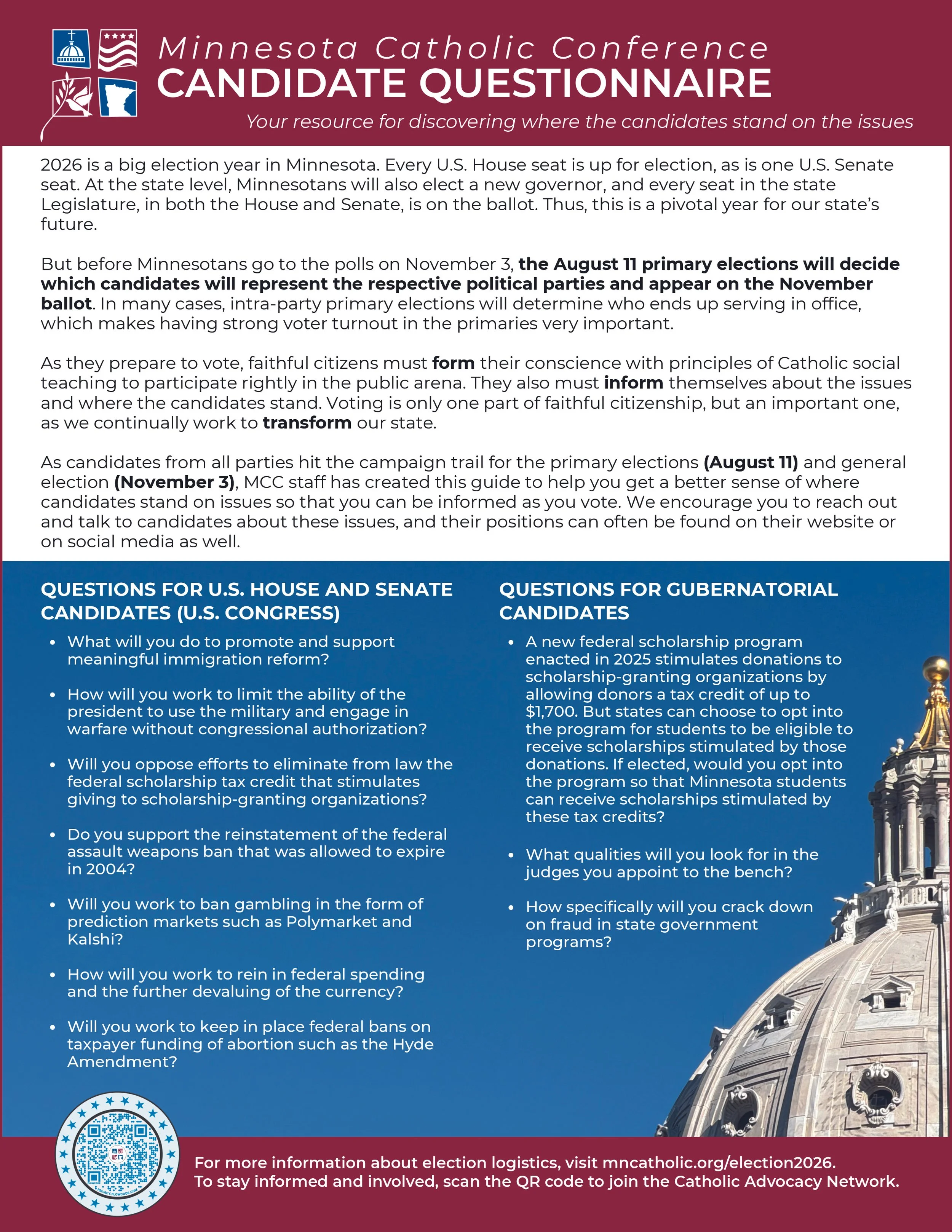
Catholics are encouraged to evaluate candidates through the lens of Catholic social teaching and human dignity.
Click HERE to view suggested questions to ask candidates.
Guided by Human Dignity:
Voting with a Catholic Conscience
Every person is created in the image and likeness of God and possesses inherent dignity. As Catholics engage in civic life, they are called to prayerfully consider how public issues and policies affect human dignity and the common good. These resources can help form consciences and guide faithful participation in the election process.
Faithful Citizenship
A guide to forming a faithful conscience and bringing Catholic values to public life and civic engagement.
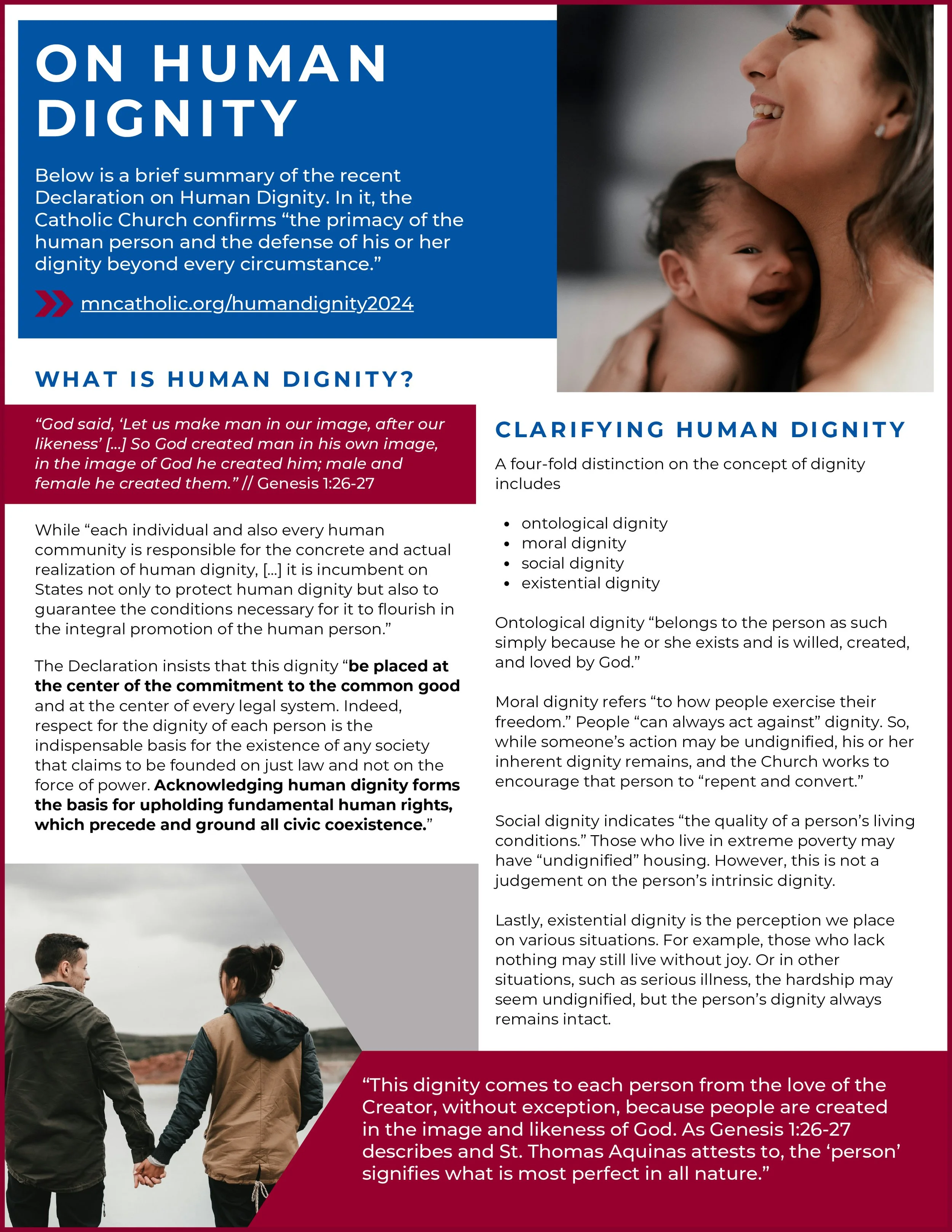
On Human Dignity -
English
A reflection on the God-given dignity of every human person and its implications for today's social issues.
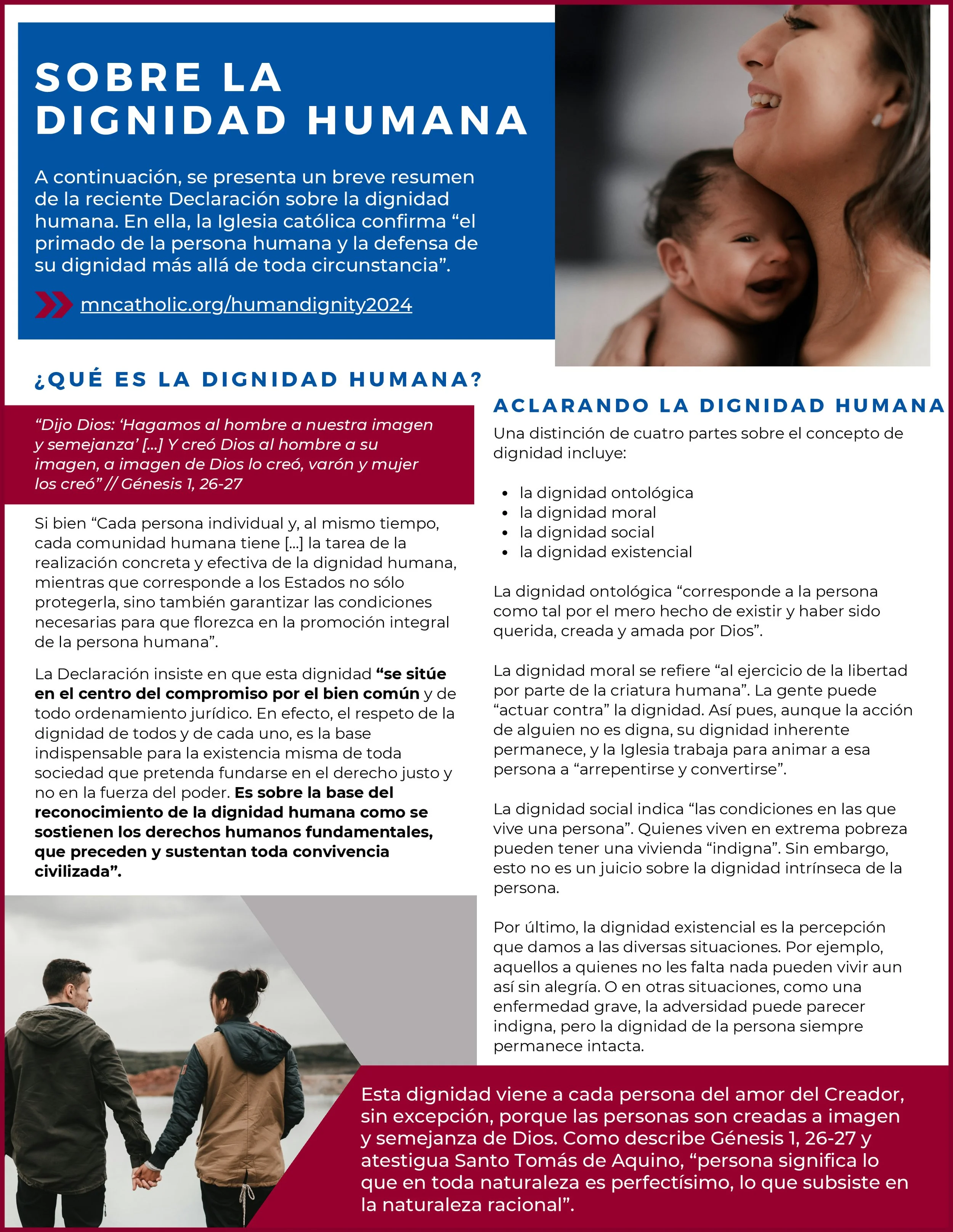
On Human Dignity -
Spanish
Una reflexión sobre la dignidad dada por Dios a cada persona humana y su aplicación a los desafíos sociales de nuestro tiempo.
Parish Guidelines for Political Activity
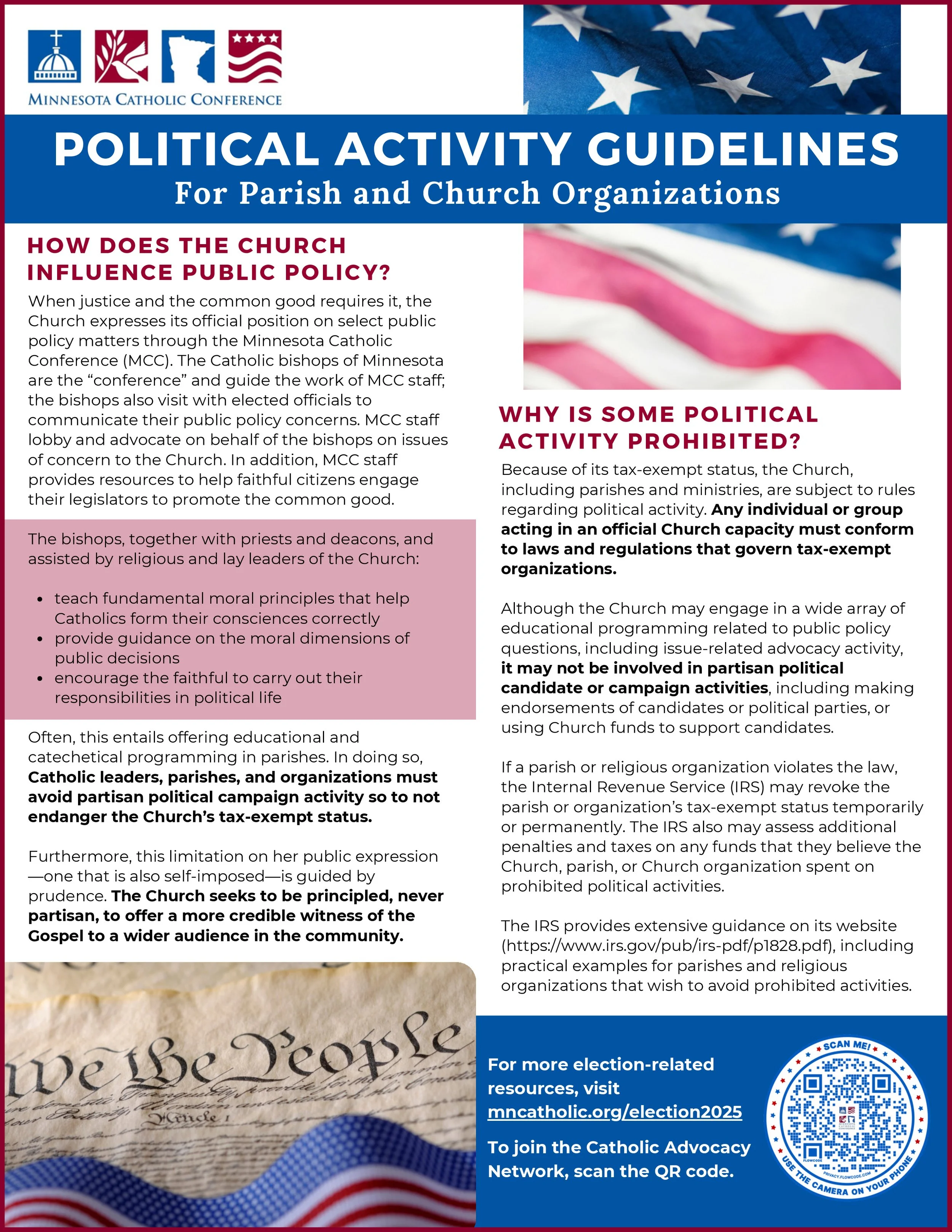
Guidance for parishes and Catholic organizations regarding election-related activities and compliance requirements.
Click HERE for parish guidelines on political activity.





More information is available at the Minnesota Catholic Conference website.
Contact the Offices of Family Life or Social Concerns for more information.

Sr. Candace Fier, ISSM
Director of Family Life
cfier@dnu.org
(507) 233-5328
Dcn. Tim Dolan
Assistant Director of Social Concerns
tdolan@dnu.org
(507) 233-5326
Tami Behnke
Director of Social Concerns
tbehnke@dnu.org
(866) 670-5163